Wal-Mart plans to use a scorecard in the US, to monitor the accuracy of the product data provided by its suppliers, Supermarket News reported. In a letter to its suppliers, Wal-Mart advised all vendors — which aren’t providing data through the Global Data Synchronisation Network (GDSN) — they have to select a data pool and provide Wal-Mart with a GLN (global location number) by January 31 and complete an initial load of accurate product data by March 10. According to a Wal-Mart presentation given last month, just 46 percent of Wal-Mart's suppliers have accurate dimension data for their products and only 55 percent provide accurate weight data. According to the retailer, only 45 percent of its suppliers, delivering 42 percent of all items, are currently using the GDSN.

In the letter, Wal-Mart said the benefits to itself and its suppliers of using the GDSN include — increased speed-to-shelf for new products; improved purchase order accuracy; optimal transportation and logistics; and preparation for a global replenishment system. In a previous communication last year to suppliers, Wal-Mart said, it was phasing out its Form 33 new item form in order to receive new item data only via the GDSN. Wal-Mart receives the data through 1Sync (formerly UCCnet), which is a subsidiary of GS1 US (formerly UCC).
 
Source: ImagesFood

WAL-MART to monitor suppliers’ data accuracy with scorecard


Thanks to an acceleration of liquor consumption trend over recent years, the Indian market is now flooded with an array of imported and domestic liquor brands, helping evolve the Indian consumers’ relatively recent affinity for wine, fine spirits and value-added beers. The liquor market has been registering healthy growth year-on-year in the country. According to Euromonitor International`s report “Alcoholic drinks in India”, alcoholic drinks` (beer, wine and spirits) market size has been growing considerably – from 1,781.8 million litres in 2004 to 2,262.6 million litres in 2006, 2,927 million litres in 2008 to the current market size of 3,276.6 million litres. The liquor market has grown by 84 per cent – approximately 1,495 million litres – between 2004 to 2009.

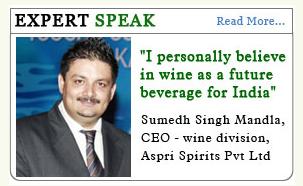
Going by the prevalent market scenario, Aspri Spirits Private Limited, one of the leading importers and distributors of premium international wines and spirits, brought to the Indian consumers some of the finest brands in the world of wines, beer and spirits such as Amarula Fruit Cream and Nederburg wines from South Africa, Roberto Cavalli Vodka from Italy, Kilkenny, an Irish cream ale and many more. Analysing the market trend , Sumedh Singh Mandla, CEO, wine division, Aspri Spirits Pvt Ltd speaks to Juhi Sharma at Imagesfood.com.

ImagesFood (IF): According to you, what`s the status of liquor industry in India?

Sumedh Singh Mandla (SSM): The liquor industry in India is fragmented and divided into various categories — imported liquor, domestic liquor, Indian-made foreign liquor (IMFL) and country liquor. Most of the categories are estimated to be growing at over 20 per cent in key cities across the country.

IF: Out of wines, beers and spirits, which liquor category has been growing at a better pace and by how much?

SSM: In the overall liquor industry, wines and beers have grown at a higher clip over the last few years; wine is estimated to have grown by around 25 per cent YoY and within spirits, the white spirits sub-category, vodka and tequila specifically have shown a better growth than the others.

IF:Typically the last two quarters of a financial year are considered to be the revenue generators for liquor brands in India. Please elaborate on the importance of the particular season for liquor industry and how much of incremental revenue on an average (in percentage) is added during this particular season to your overall revenue pie?

SSM: The period from October to February is clearly the best period for liquor sales in India. Various factors contribute to this uptick, but festivals such as Diwali and Christmas coinciding with a peak tourism season across India are the two key contributors for higher overall liquor consumption.
Months from November to January generally contribute over 40 per cent of annual sales for us. However, the same period last year was very slow due to the terror attacks and the global economic slowdown.

IF: What is the importance of packaging innovation and value-addition introduced by a lot of liquor brands during the festive season?

SSM: Attractive packaging has been a key aspect of compulsive and general buying for consumers and liquor is no exception to the rule. We Indians always look for better value for each purchase, therefore special gift packs always help by adding more value and creating increased demand.

IF: According to you what are the expected trends in respect with liquor consumption in future. Any expectations for any particular liquor category to witness more consumption than others?

SSM: I personally believe in wine as a future beverage for India, as there are health benefits associated with drinking wine, thereby drawing in an increasing number of consumers opting for healthy lifestyles. At this point of time, the wine segment in size is certainly miniscule as compared to spirits and beers, but there lies a huge potential in the times to come.

IF: Please tell us about the largest selling liquor brand in your portfolio.

SSM:Currently Don Angel Tequila in our portfolio is the largest selling single label that we import exclusively in India. 


Source:ImangesFood

“I personally believe in wine as a future beverage for India”


India shall continue to be world's largest milk producer with an expected outlook of 110 million tonnes in 2008-09, revealed National Dairy Development Board (NDDB).

"India's milk production was 104.8 million tonnes in 2007-08 and in 2008-09 it is expected to be 110 million tonnes," NDDB said in a statement recently.

On an aggregate, the co-operatives procured around 14 per cent of the national marketable surplus covering around 21 per cent of the country's villages and 18 per cent of the rural milk producing households, India's leading dairy development agency said.

The milk co-operatives marketed around 7.3 million tonnes of liquid milk, an annual increase of 5.7 per cent, the statement said. A National Dairy Plan has been prepared with an estimated outlay of around Rs 17,300 crore spanning 15 years, it said.

To increase milk productivity, NDDB has forged alliances with various institutions to produce high genetic merit bulls in the country, the statement added.

Source:ImagesFood

India continues to be world's largest milk producer


Ahmedabad-based food and bio-industrial conglomerate, has acquired Vigo Bio-tech Dairy Pvt Ltd for about Rs 20 to 25 crore. Anil Hospitality Ventures Ltd (AHVL), a company of Anil Group, has picked up a controlling stake of 90 per cent in Vigo Bio-tech having its operation base near Halol, 40 kms from Vadodara.

"Through this acquisition, the company plans to drive growth by leveraging emerging opportunities in food processing sector," said Amol Seth, managing director, Anil Group.

The acquisition will help Anil to harness Vigo's expertise to address the entire value chain of dairy farming, including milk production and milk products. So far the company has been operating in various stages of farm-to-fork value chain and now it has decided to move up the value chain. The company is geared up to enter the food processing sector with wide range of food products.

"Vigo offers multiple synergies with our existing businesses. We have planned an investment of Rs 75 to Rs 100 crore to scale up the operations of the acquired entity in next 12 to 18 months," Seth added. Currently, Vigo markets cow milk in and around Vadodara. Post expansion, Anil Group intends to produce speciality dairy products.

Vigo has already installed a high-tech 80-unit rotary milking parlour procured from dairy master of Ireland and this is Asia's largest and the fourth largest in the world. The dairy player already has 550 Holstein Friesian hybrid cows and Anil Group is looking at increasing the number substantially by the fiscal 2010-11.

Initially, Anil Group will use milk produced from Vigo's farm. However, it may start milk procurement from outside as it scales up its operations. "As part of our strategy to enter into food processing sector, we are open to further acquire players operating in distribution and production of milk products space," he said. Anil Hospitality currently runs a chain of dinning halls and cafe, which it is considering to expand.

Source— ImagesFood.com

Anil Group acquires Vadodara-based Vigo Bio-tech dairy


ISLAMABAD: Agriculture ministers of Pakistan and Malaysia will explore the untapped market potential of Halal meat next week in Islamabad in an attempt to meet domestic requirements of both countries and export to neighbouring countries in the region, The News has learnt.

The Malaysian agriculture minister along with a high-level delegation of agro-based industries would meet with his Pakistani counterpart and other officials in the federal capital from Dec 14 to 17 to discuss expanding trade, particularly in Halal meat, an official of the food ministry told The News.

Pakistan and Malaysia have already struck a Free Trade Agreement, but bilateral trade figures are in favour of Malaysia.

Such cooperation will not only go a long way towards balancing trade between the two countries, but will also help Pakistan in fully utilising its agricultural and livestock products.

Malaysia’s exports to Pakistan last year totalled 5.95 billion ringgit while imports amounted to 363.3m ringgit.

Out of 57 Muslim countries, interestingly only Bangladesh, Iran, Malaysia, Pakistan, Egypt, Jordan, Lebanon and the UAE are in the business of Halal meat while the rest are net importers of Halal meat from developed countries like the US, China, India, Brazil, Argentina, Uruguay, Paraguay, Australia, Thailand, Kenya, France, Singapore, Spain, the Philippines and the Netherlands.

Besides deliberations on Halal meat, the official said the Malaysian delegation would also sign a memorandum of understanding with a local beverage company and hold talks with officials of the Board of Investment.

Pakistan has 60 million cattle, 55 million goats and sheep and 30 million buffaloes. Besides exporting meat to the Middle East, Pakistan also exports live animals to Central Asia.

Meanwhile, a high-level delegation of the Ministry of Agriculture and Agro-based Industry and Department of Veterinary Services of Malaysia is currently in Pakistan to ascertain prospects of forging strategic cooperation in the field of agriculture and veterinary services.

The delegation after their arrival in Islamabad on Dec 7 has been holding meetings with representatives of the Ministry of Livestock and Dairy Development and agriculture ministry, and has also been visiting various research institutes including the University of Veterinary and Animal Sciences, Artificial Insemination Centre and Veterinary Research Institute, Lahore.

The delegation will also examine world-class Halal food infrastructure, set up by the private sector and will visit the Livestock Production Research Institute, Okara, and Buffalo Research Institute, Pattoki, besides meeting officials of the Punjab Board of Investment and Trade.


Source: www.thenews.com.pk

Pakistan, Malaysia to explore Halal meat market


After acquiring Falafel, India's first Mediterranean/Lebanese food chain, the Mirah Group plans to increase its outlets from seven to 30 by 2010. Confined to Mumbai for the present, it is looking at new markets such as Bangalore and Pune.

“Once we get a central kitchen, we could open 10-12 outlets pretty fast. The investment is also low and the time taken (to start operations) is also less. The recipes are standardised,” Mr Gaurav Goenka, director, Mirah Group said in a media report.

The flavours from Falafel include hummus plates with a variety of toppings, green salads, a range of pita breads, desserts and their signature in-house lemonade juice. The brand was introduced in India in 2008 by JB Group's JB N JEG Foods. Mirah acquired the food chain three months back.

Mirah, the owners of Gujarati food chain Rajdhani and newly launched Citrus Hotels, will invest Rs 300 crore across its hospitality ventures till 2010. Of this, Rs 200-250 crore will go towards Citrus and the rest for Rajdhani and Falafel.

The first Citrus Hotel was launched in Pimpri, Pune, last month. The 143-room property includes 43 service apartments which will open in the next three months. “Citrus is a mid-market, full service hotel. We will be unveiling five more within a month or so in Goa, Lonavala, Mahabaleshwar, Sriperambudur and Alleppey and are scouting for other leisure and business locations too,” said Goenka.

As a result, the company could have 400 rooms by end-2010. These hotels were already operational when Mirah acquired them and later rechristened Citrus. The company is now exploring growth routes through management contracts, greenfield ventures or acquiring hotels.

Rajdhani, on the other hand, has 45 outlets in 16 cities with a presence in Dubai and Oman.
Apart from hospitality, the Mirah Group is present in real estate development, travel, computer education, wind energy generation, textiles and international trading. Hospitality contributes to 35 per cent of its overall revenues, said Goenka.

Source:ImagesFood

Mirah to open Falafel outlets in more cities


Ice cream major Haagen-Dazs – which recently opened its flagship outlet in India at Select CityWalk Mall, New Delhi – landed in trouble when the company displayed controversial posters outside the outlet recently. The banner displayed a message saying 'preview for international travellers' and ‘Entry restricted only to holders of international passports.’

On December 15, an Indian man who saw the sign was turned away from the store — but only because of lack of space due to the weekend rush, according to Haagen-Dazs. Not to be outdone, the man took a photograph and posted it on the internet, inciting a hail of protests that left the company red-faced.

Anindo Mukherji, managing director, General Mills India has released a media statement saying, “There have been some reports alleging that the recently opened Häagen-Dazs shop denied access to Indians. We vehemently and categorically deny this. Häagen-Dazs products and our Häagen-Dazs shop in India are and will always be for our consumers in India.”

Clearing the controversy surrounding the offending poster, Mukherji says, “The poster in question was part of initial local store communication at a few locations within the same mall announcing the opening of the new Häagen-Dazs shop in the property. The message was intended to suggest that you can enjoy, for instance, a taste of the French Riviera without travelling to France – at Häagen-Dazs. Unfortunately the reference to the international passport holder on the poster may have led to a significant miscommunication. This was completely unintended and we apologie for creating the misimpression that may have hurt our sentiments as Indians.”

The company asserts that Haagen-Dazs is here to obviously tap the Indian market, not keep it out. Further, Mukherji confirmed that customers were refused entry only momentarily -- due to overcrowding of the outlet.

Meanwhile, the irate customer is evidently enjoying his fifteen minutes of fame.
 
Source: ImagesFood

We apologise for creating the misimpression: Haagen-Dazs


Mumbai-based wine importer and distributor, Finewinesnmore (FWM) recently launched the first wine club W3 (Wine, Women and Wit) for women in the city. The club was launched by Dharti Desai, founder and CEO, FWM along with entrepreneur Chandni Dhall. There are plans to open wine clubs in Delhi by February 2010 and in Bengaluru by April 2010.

The main aim is to increase wine drinking culture among women and will also entail events associating wine with shopping, travel and fashion. Before launching the wine club, FWM conducted market research to understand the present characteristics of women wine drinkers in Mumbai. The research revealed that about 60 per cent of total wine drinkers are women while about 50 per cent of all wine purchasing is done by women. “This trend reflects that women are a driving force in the wine industry. Hence, it was essential for us to design a club to cater to this growing segment,” informed Desai.

The club presently has 27 partners, which will offer special privileges to the club’s members. The partners include Myrah Spa, Lancome, Thomas Cook Indulgence and Valhalla restaurant in Mumbai. While the partners are presently Mumbai centric, the club will increase its associates with the launch in new cities across the country. The club will conduct two events every month: First being a wine education and appreciation session and the second will be an event associating wine with travel, shopping and fashion. The education will focus to increase the consumer base of wine drinkers in the country, Desai informed. FWM also plans to initiate wine sales through the club, offering special deals to its members and facilitating home shipments.

FWM launches first women wine club W3 in Mumbai


RAWALPINDI: The sugar crisis is unlikely to end despite the agreement between the federal government and the sugar mill association raising the price of the commodity from Rs36 to Rs55 as they did not take provinces and the people on board.
The federal government and sugar mill owners chose the occasion ahead of Ramazan when people were anticipating all time high prices of essential commodities.
However, it should not be forgotten that the government of Ayub Khan had gone for raising just minor increase in sugar price. Last week, sugar price rose to all time high to Rs60 to Rs65 in various parts of the country.
The government raised the price of sugar abruptly from Rs38 to Rs50 on the plea that the sugar price in the international market was high. It was also announced that if imported from Dubai the sugar would cost the public Rs65 per kg.
The increase of Rs12 per kg in the price of sugar is considered as the most unpopular decision of the federal government.
The first reaction to the federal government’s decision to increase sugar price came from the Punjab government saying Islamabad did not consult the provincial government over increasing the sugar price.
The provincial government is determined to sell sugar at Rs40 in the province.
The Punjab Chief Minister Shahbaz Sharif appealed to the federal government to relax sales tax and excise duty on sugar.
The Punjab government alleged that the Federal Minister for Production Mian Manzur Ahmad Watto had unilaterally decided to raise the price of sugar without consulting Punjab.
Mr Shahbaz Sharif said the Punjab government recovered more than 250,000 bags of sugar from hoarders in a bid to sell sugar to public at reasonable price, but the decision of the federal minister in fact quashed the move of the provincial government.
Despite increase in the price of sugar, the commodity is still not available in the open market.
The consumers were visiting Ramazan bazaars and utility stores where sugar is available at Rs40 and Rs38 respectively.
The solution of sugar crisis is not in sight and it is feared that during Ramazan the crisis is likely to assume new dimensions.

Source: Dawn.com

No solution to sugar crisis in sight


The Bharti Wal-Mart JV has been in news ever since the partnership took effect in late 2006. The reasons are many – from its seemingly cautious approach in store expansion to its business strategy to its community building initiatives in India, the retailer has been the subject of discussion among Indian and international retailer keenly studying the Indian marketplace. In an exclusive interview ImagesFood.com, Arti Singh, VP, Corporate Affairs of Bharti Wal-Mart shares the experiences, learnings and future plans of Best Price Modern Wholesale, the JV`s cash and carry format in India.

ImagesFood (IF): How has the existing cash and carry format in Amritsar fared so far? What are the key learnings from the experience?

Arti Singh (AS):The response has been very good. We have over 35,000 primary members at our first store in Amritsar. Best Price Modern Wholesale offers a one-stop shop to commercial customers like kirana stores, thus saving them time and money and offering them a wide array of quality products at best prices. The assortment, service and store layout of our cash-and-carry store is customised to the specific needs of commercial customers so that they can benefit from high quality products to help them enhance their businesses and profitability.

As we`ve studied the Indian market, we`ve been impressed by how much we have learned from the existing system. It`s a system that works -- quite often against the odds.

However, there is a need for increased efficiencies that can help minimise wastage, particularly of fresh fruits and vegetables. Although India is the second largest producer of fruits and vegetables in the world, it is estimated that huge quantities of fresh fruits and vegetables -- as much as 40 per cent -- are lost due to the lack of a cold chain infrastructure.

This is where the global experience, expertise and best practices of Wal-Mart can help in making a difference by working with the existing supply chain infrastructure and make it more efficient. The objective is to cut the waste, not the middlemen who can play a very important part in the entire supply chain.

We are looking at saving in every aspect of that supply chain. It`s not just about negotiating better prices with the suppliers; it is actually about working with suppliers to remove any inefficiency in the supply chain. We are working with suppliers on packaging, on stock control, better management and inventory, and so on. All those savings which come out of that effective management of supply chain will be passed on to the kirana stores and other business owners, who are our customers.

IF: Are you intending to open more cash & carry outlets anytime soon? Any locations shortlisted?

AS: Bharti Walmart is expected to open 10 to 15 wholesale cash-and-carry facilities and employ approximately 5,000 people over the next three years. We are initially targeting tier II and III cities. For the next couple of years, the focus will largely be Punjab and then moving to the states of Haryana, Uttar Pradesh, Rajasthan, Delhi and Madhya Pradesh.

IF: What criteria have determined choice of these locations?

AS: Punjab is a great market and full of unexplored opportunities, besides acting as a hub for various other cities in north India. Moreover, as the focus of our supply chain is Punjab, Amritsar was the natural choice. While there are an estimated 12 million kirana stores in India, the largest FMCG companies in India are able to serve less than 10 percent of these outlets directly. As a result, 90 per cent of kirana stores are not directly serviced. Our B2B wholesale cash-and-carry stores offer a one-stop-shop way for kirana stores to get access to quality products and at the prices they need. In turn, they can pass on these benefits to their customers. This is particularly true for tier II and III towns like Amritsar in Punjab.

IF: Going forward, as the scale of operation increases, how would your private label products impact the fortunes of manufacturer brands?

AS: Private label is a very intrinsic and important part of good retailing and wholesaling. While supplying to Bharti Retail stores, we have been running a private label programme. It, of course, requires a deep understanding of supply chain, and developing suppliers so that they are ethically and quality right. We have the relevant expertise and we have brought this to India.
We also have a lot of international private label suppliers who are interested in setting up shops in India to create private labels, not only for Bharti and Walmart stores but also for the entire industry. We are working on getting them to India. So, there is a lot of work happening in that area, and this will benefit the entire industry.

IF: Besides supply chain inefficiencies, if you were to name one top-of-mind challenge of operating in India, what would it be?
AS: The easiest thing to do in cash-and-carry or retail is scalability, to roll out stores. However, the real challenge is to keep feeding these stores consistently with good quality products at the right price. We are here for the long term and we recognise the importance of having the back-end infrastructure and merchandising plans in place so that we can provide the optimum assortment mix that will appeal to our members. Readiness must first be put in place at the back-end, and not the other way round.

as told to Bhavya Misra
Source: ImagesFood

"The Indian system works – quite often against the odds.”

FoodMarketPK
Created By PK Group Online Business, Find the latest online retail news, Pakistan retail news and information regarding retail market research at foodmarketpk.blogspot.com

Copyright @ 2009 foodmarketpk.blogspot.com. All rights reserved.

 
AFM © 2015 - Designed by Templateism.com | Distributed By Blogger Templates